


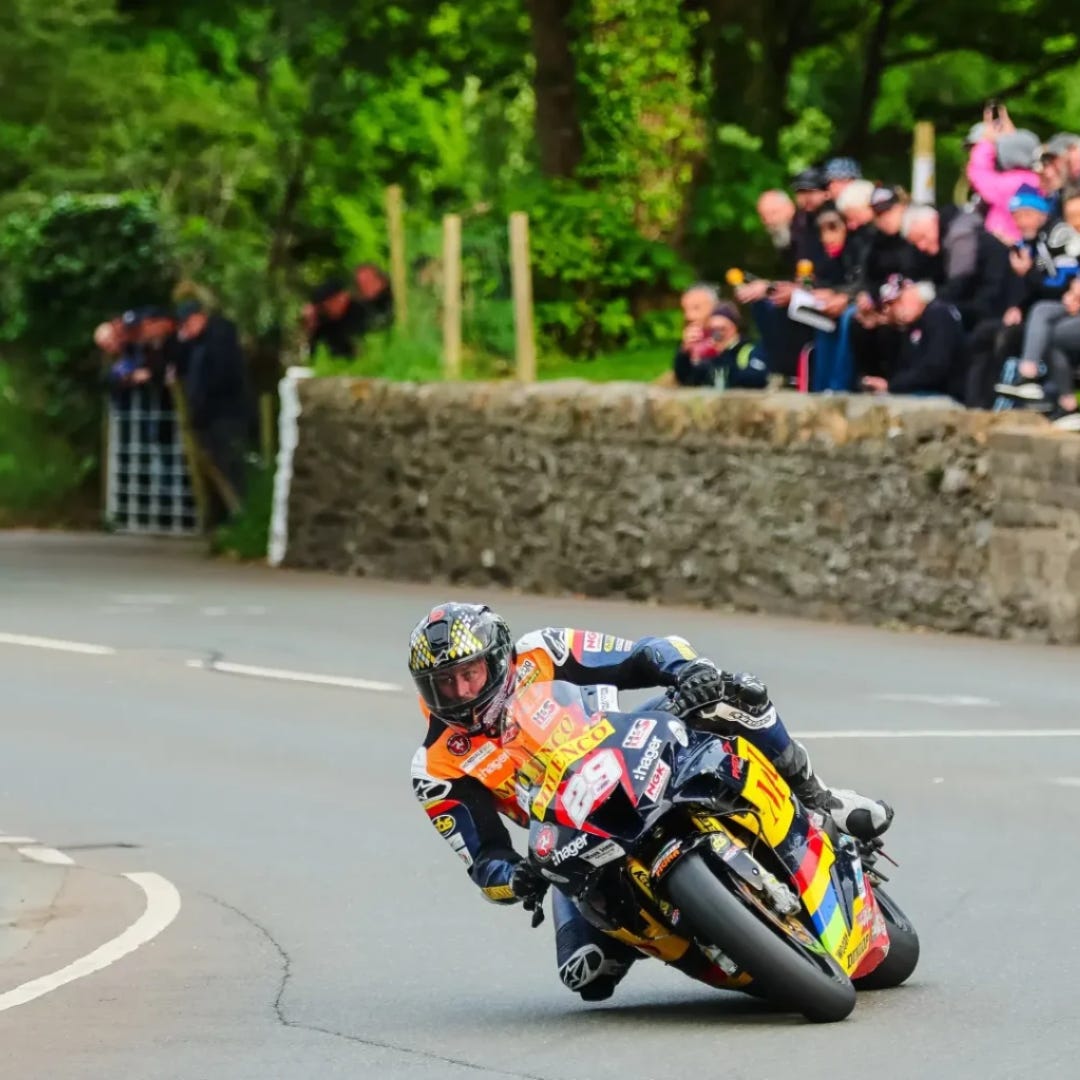
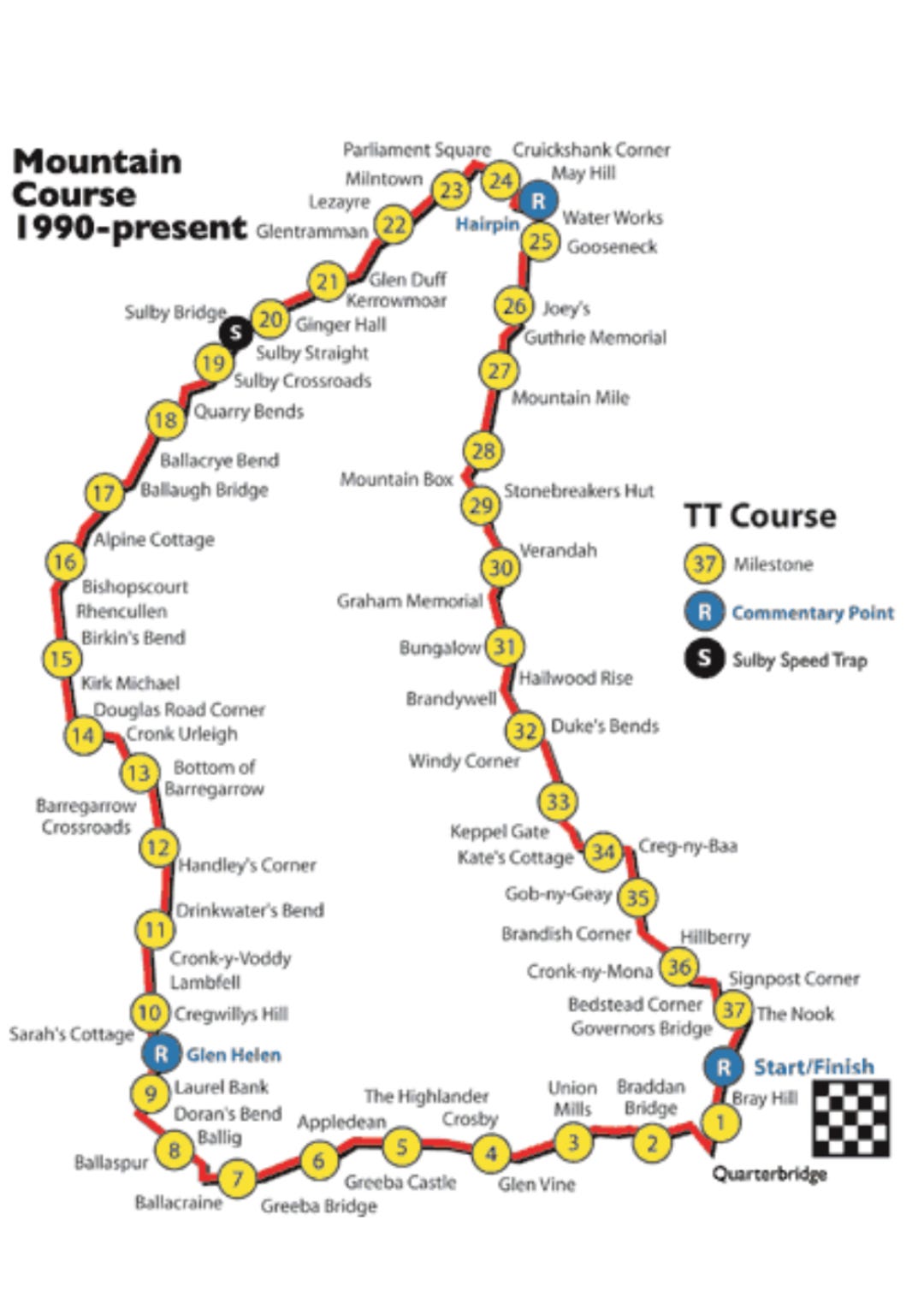
In old money, it’s 37.73 miles. For us speed freaks Down Under, 60.72km.
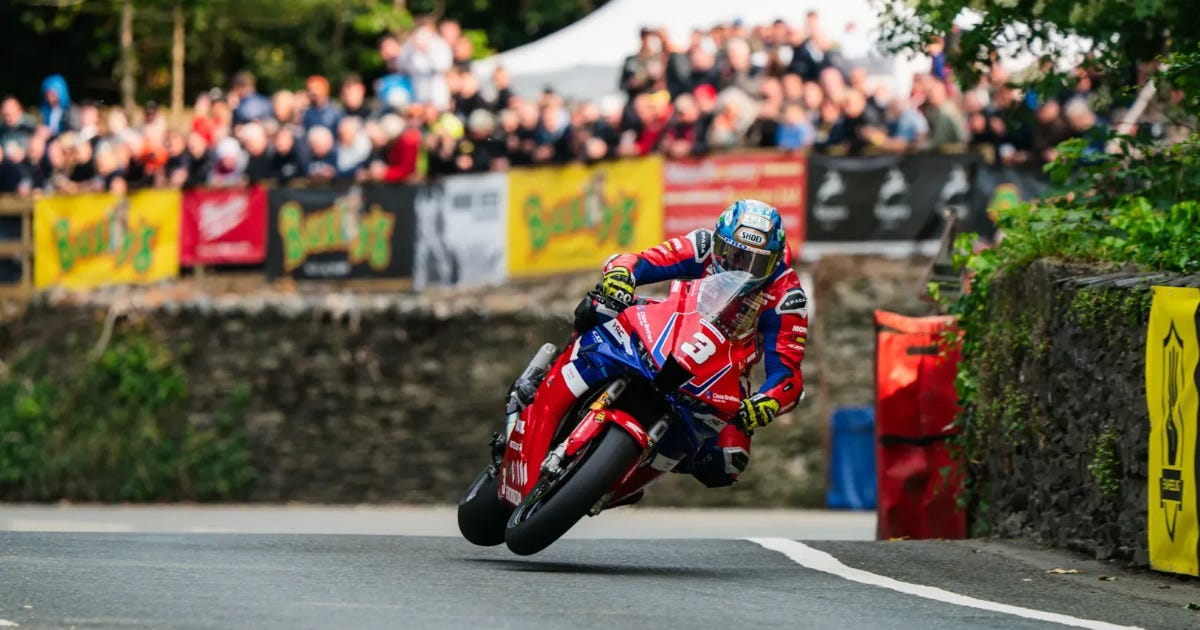
Combined, there are more than 200 corners with curbs, stone walls, trees and even the front doors of local houses within a gnats whisker of the racing line. At full fang, we’re talking speeds approaching 321kmh (200mph). On bumpy public roads.
Welcome to the 115th edition of the iconic, incomparable Isle of Man Tourist Trophy Motorcycle Races.
For two weeks, this is motorcycle mecca, the ultimate test of man and machine minus run off areas and gravel traps. It promises a unique test of skill and bravery that simply wouldn’t get past health and safety if it were started today. Thank goodness they thought of it in 1907 and have resisted calls for it to be banned since – despite the TT claiming the lives of 270 riders, eight of them Kiwis.
Whakatāne mechanic Mitch Rees is back for a second crack at the infamous Mountain Course after claiming the Vernon Cooper Trophy as the top solo newcomer on debut last year.
The three-time NZSBK, five-time and reigning Suzuki International Series champion and serial Cemetery Circuit winner is again racing for the Batley-based Milenco by Padgett’s Racing Team.
He’ll campaign Hondas in the following classes:
• Milwaukee Senior TT
• RST Superbike TT
• RL360 Superstock TT
All on a Honda CBR1000RR-R Fireblade SC82, “…and that’s on just a Superstock bike, even in the Superbike and Senior TT,” Rees said.
• Monster Energy Supersport TT (Honda CBR600)
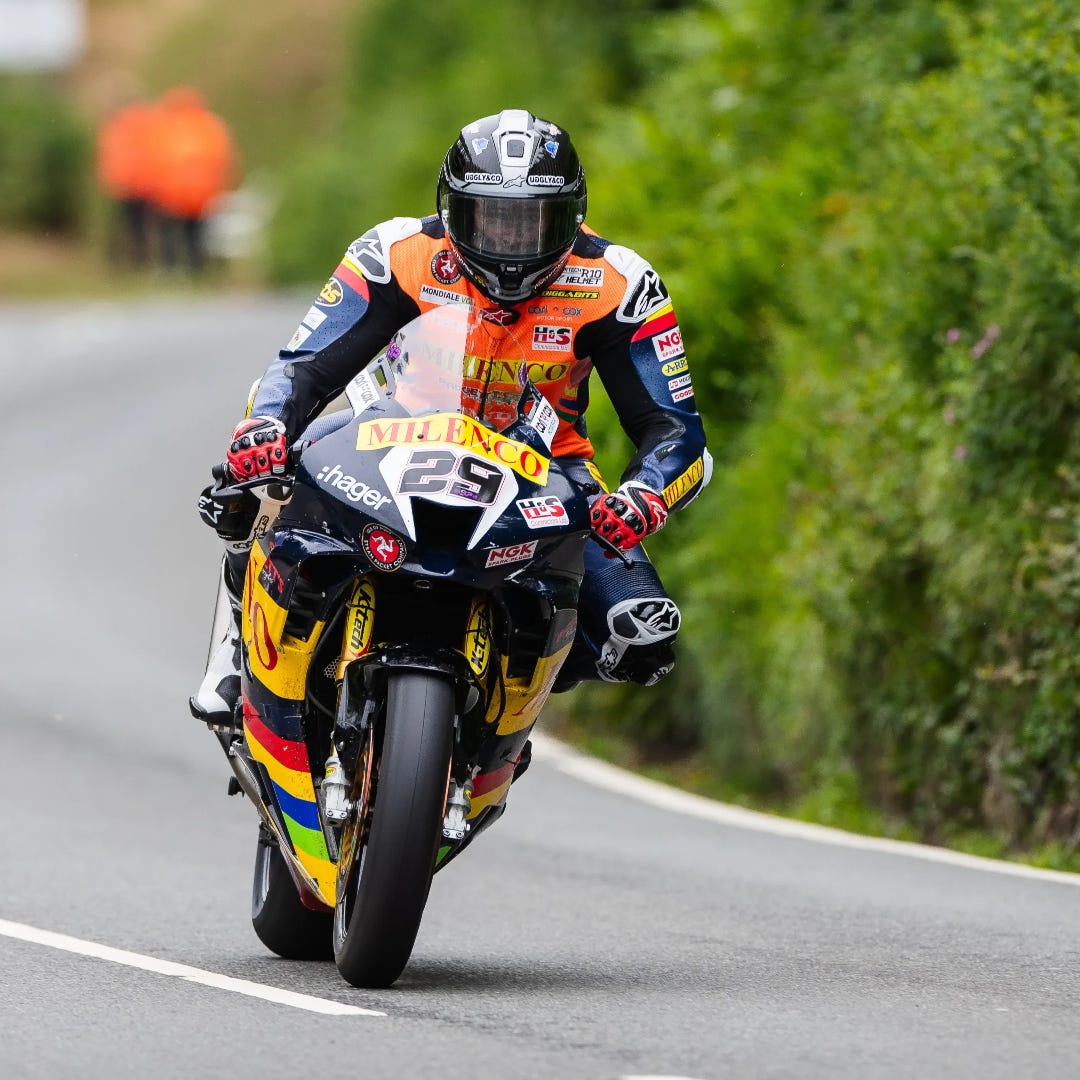
That’s potentially five races across the six official race days from next Saturday, plus practice and qualifying throughout the first week.
Rees suffered a mechanical DNF early into his debut IOMTT race last year, the RST X D30 Superbike TT opener. But he recovered to place 23rd and 19th in the two Superstock TTs, recording a best lap of 126.8mph.
The magic 130mph (209kmh) mark is a goal in 2026, he told BikeRider recently, as is getting to race the Senior TT which was cancelled last year due to unsafe wind gusts following earlier rain.
“Last year was a massive learning curve. The TT is unlike anything we have back home in New Zealand. I felt we made solid progress despite the conditions, and now I know what’s required.
“The goal is to move towards that 130mph mark…if I can get close to that on the big bike, I will be happy.” - by Kent Gray.
The Format
First Week
Starts with a single untimed session on the opening night, Monday, then every session that follows counts as timed qualifying. The week is essential for tuning of the bikes and gives riders a chance to reacquaint themselves, not just with the course but the speed and endurance required. During the first week, for practice and qualifying, superbikes share the track with Superstock machines, Supersport run together with Sportbike and Sidecars have standalone sessions.
Week 1 - Schedule
All local times (NZ is 11 hours ahead of Isle of Man Time)
Monday, May 25
UNTIMED FREE PRACTICE
10:45 – Newcomer Speed Controlled Lap (Solo and Sidecar)
11:00 – Supersport / Sportbike
11:45 – Sidecars
12:40 – Superbike / Superstock
QUALIFYING 1
14:15 – Supersport / Sportbike
15:00 – Sidecars
15:55 – Superbike / Superstock
Tuesday May 26
QUALIFYING 2
18:30 – Superbike / Superstock
19:20 – Supersport / Sportbike
20:15 – Sidecars
Wednesday, May 27
QUALIFYING 3
13:00 – Supersport / Sportbike
14:00 – Sidecars
14:55 – Superbike / Superstock
QUALIFYING 4
18:30 – Superbike / Superstock
19:20 – Supersport / Sportbike
20:15 – Sidecars
Friday, May 29
QUALIFYING 5
10:30 – Superbike / Superstock
11:25 – Sidecars
12:20 – Supersport / Sportbike
QUALIFYING 6
13:15 – Superbike / Superstock
14:20 – Sidecars
15:10 – Supersport / Sportbike
Second Week
The top 20 competitors from the solo classes and top 10 pairings from the sidecars are all given pre-determined race numbers based on previous experience and results.
The fastest combined qualifying results determine the start numbers for the remainder of each field.
Racing is run under a time trial format with riders called up in numbered order, starting from 1-20. Once teams have done their last minute prep on the grid, riders head through what is known as “no man’s land” before the infamous tap on the shoulder sends them on their way. Riders start at 10 second intervals, making the TT a race against the clock, the course and themselves, as much as their rival competitors.
Up to 60 starters in each class, and three, four or six laps depending on the class.
There are 10 races scheduled with the Milwaukee Senior TT the most prestigious and traditionally run as the last race of week. The fastest total race time decides the winner.
Week 2 - Schedule
All local times (NZ is 11 hours ahead of Isle of Man Time)
RACE DAY 1 - Saturday, May 30
10:45 – RL360 Superstock TT Race 1 (3 laps)
13:30 – Motul Sidecar TT Race 1 (3 laps)
RACE DAY 2 - Sunday, May 31
13:30 – RST Superbike TT (6 laps)
RACE DAY 3 - Tuesday, June 2
10:45 – Monster Energy Supersport TT Race 1 – (4 laps)
14:15 – Carole Nash Sportbike TT Race 1 – (3 laps)
RACE DAY 4 - Wednesday, June 3
10:45 – Motul Sidecar TT Race 2 (3 laps)
13:30 – RL360 Superstock TT Race 2 (3 laps)
RACE DAY 5 - Friday, June 5
10:45 – Monster Energy Supersport TT Race 2 (4 laps)
14:00 – Carole Nash Sportbike TT Race 2 (3 laps)
RACE DAY 6 - Saturday, June 6
11:00 – Milwaukee Senior TT (6 laps)
Superbike and Senior TT: 6 x laps = 226.38 miles.
NB: Average time just under 1h 45mins. Bikes require two pitstops for fuel and tyres (as required)
Supersport: 4 laps = 150.92 miles
NB: One pitstop.
Superstock, Sportbike and Sidecar: 3 laps = 113.19 miles.
NB: One pitstop barring Sidecars which have enough fuel to run without a pitstop.
Pitstops last between 40 and 60 seconds. Crews of three or four in pit lane. Pitlane speed limit is 60km/h. Strict time penalties enforced for any rider that exceeds this limit.
The Course
The Isle of Man situated in the Irish Sea and is centrally located between Scotland, England, Wales and Ireland. A lap of the Snaefell Mountain Course is a test of precision, consistent speed and unerring courage.
The fastest riders complete a lap in under 17 minutes at speeds averaging over 130 miles per hour.
For context, the largest purpose-built track in the British Isles is Silverstone Grand Prix Circuit which measures 3.66 miles, has 18 corners and laps speeds averaging around 110mp/h.
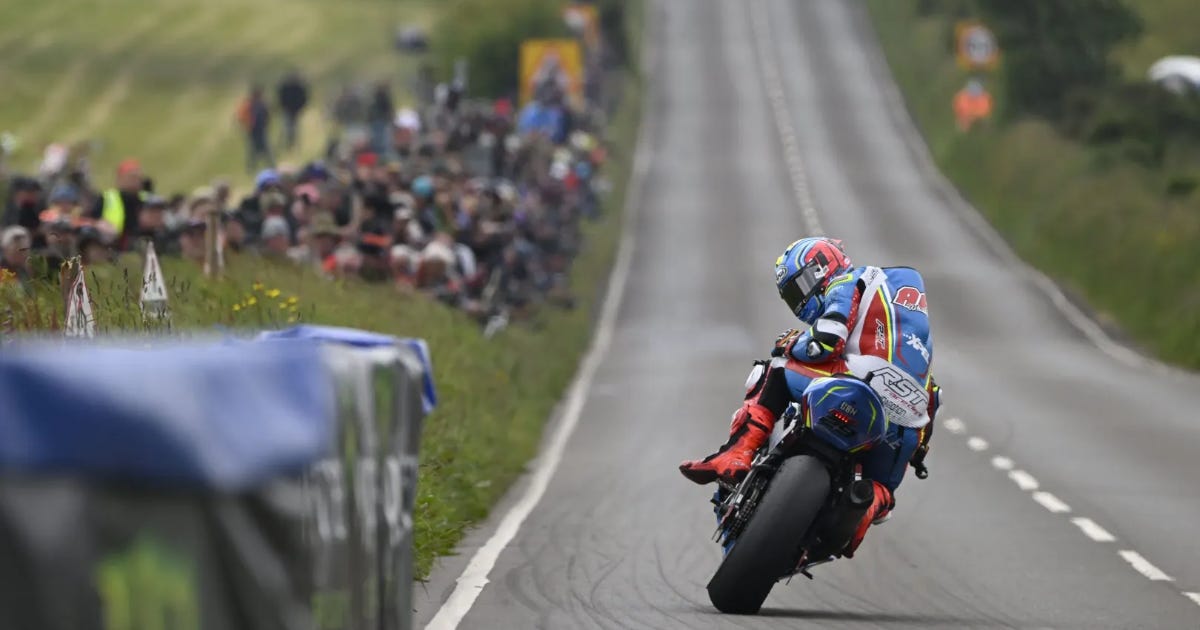
Unlike purpose-built tracks, the Mountain course has no run-off areas or gravel traps. These are public roads closed for two weeks where riders must contend with changing surfaces, elevation changes, different cambers and grip levels, all with little margin for error. Not only do they have to navigate the corners, they also have to master the bumps, jumps and elevation changes that make the Isle of Man roads a unique physical test “where road maintenance, weather and everyday traffic subtly reshape the course from one year to the next,” the official TT website says.
The Mountain Course is split into six sectors, each holding its own distinctive characteristics:
Sector 1: Runs from the start-finish line at the TT Grandstand in the Isle of Man’s capital city of Douglas, and continues through the towns of Union Mills, Glen Vine, Crosby and Greeba, finishing in the tree lined valley of Glen Helen, a fraction under 10 miles. Known for its number of 5th and 6th gear corners and popular spectator vantage points at Brae Hill, Crosby and Gorse Lea. Takes around 4 minutes at race speed.
Sector 2: Climbs from Glen Helen onto Cronk-Y-Voddy straight, the fastest part of the course across 7½ miles to Ballaugh Bridge. This section crosses open country side with long rural straights and flying corners at sustained high speeds, from bottoming out in Barregarrow to flying over Ballaugh Bridge. A test as much as machine as it is on man and approximately 3 minutes at race pace.
Sector 3: Measured from Ballaugh Bridge to Ramsey Hairpin, covered again in around 3 minutes across just over 7½ miles. Well known as the roughest and most undulating section of the entire track. You’ll see plenty of coverage from Ballaugh jump, Quarry Bends and Sulby Straight where riders reach speeds of 321kmh (200mph) before reaching Parliament Square in the northern most town of Ramsey.
Sector 4: Starting from Ramsey Hairpin, the riders begin the section that gives the Mountain course its name. The Gooseneck, Joeys, Guthrie’s, Mountain Mile, Mountain Box, Verandah and checkpoints up to the foot of Snaefell at The Bungalow, one of the most popular spectator spots. Snaefell is the highest mountain on the Isle of Man, measuring 2037ft above sea level. It’s just under 6½ miles and is regularly completed in just over 3 minutes.
Sector 5: Almost 5½ miles long, Sector 5 begins at The Bungalow and climbs up to the highest point of the course at Hailwood’s Rise at 1385 feet above sea level. Then begins the decent down the mountain section to Cronk-ny-Mona with the sector ticked off in a little over two minutes.
Sector 6: The final sector is also the shortest. At just under 1½ miles long, the leaders will cover this in under 60 seconds. Signpost Corner, The Nook and Governor’s Bridge whiz by as glory beckons at the TT Grandstand.
The Classes
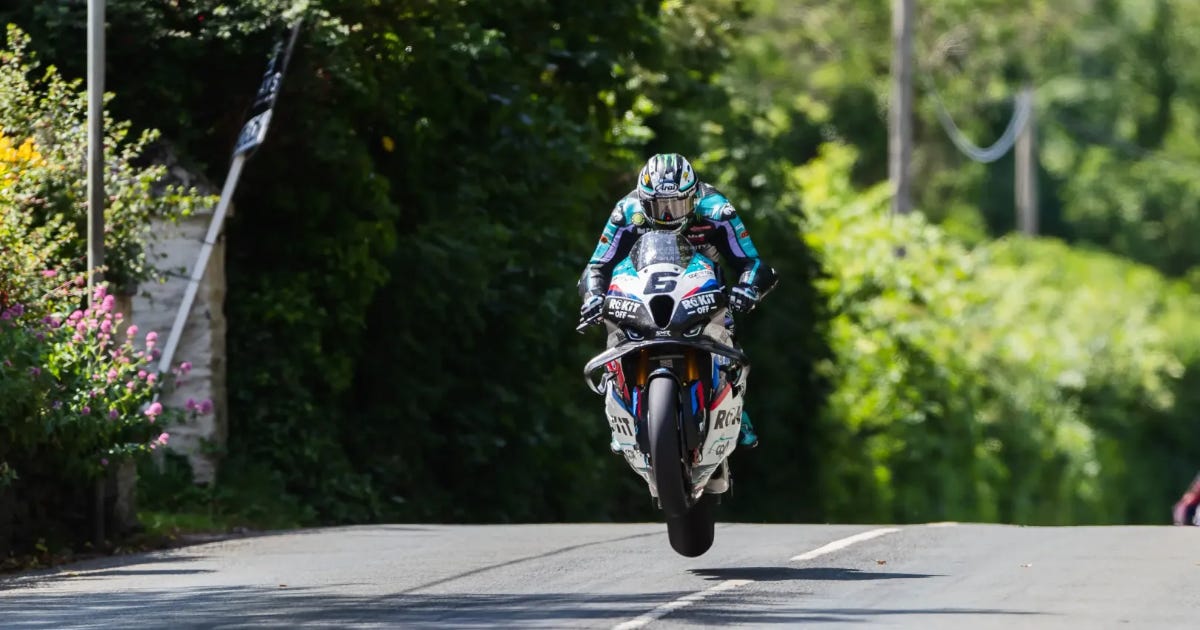
Superbike: The fastest and most powerful of all of the classes. On paper. Based on 1000cc production bikes, extensively modified for the TT course. Producing over 200 brake horsepower, capable of reaching top speeds in excess of 200mph. Must maintain the same profile as their dealership showroom equivalents, as seen from the front, rear and sides of the bike. BMW, Ducati, Honda, Kawasaki, Suzuki and Yamaha models dominate the class with teams able to fine tune engines, electronics, suspension, brakes and swing arm. The current lap record for the Superbike class stands at 135.970mph, a 16:38.953 effort set by Michael Dunlop on a Honda CBR1000RR-R Fireblade SC82 in 2024.
Superstock: The outright TT lap record was set in the Superstock class, a 136.358mph lap recorded by Peter Hickman on a BMW M 1000 RR in 2023. His time was 16:36.115.
The Superstock class also incorporates 1000cc production sport machines but the technical regulations are even more restricted than the Superbikes, keeping the bikes closer to the showroom equivalent. Limited modifications are allowed for safety reasons but the engine, frame and electronics must remain standard. The ultimate proving ground for production-based motorcycles.
Supersport: Lighter and less powerful than Superbikes and Superstock, Superport bikes can however be extensively modified. The current Supersport lap record stands at 17:21.605 and 130.403mph, set by Michael Dunlop on a Yamaha YZF-R6 in 2023, a 600cc, four-cylinder machine. A recent evolution in the class has seen the inclusion of 750cc, 765cc three-cylinder and 955cc two-cylinder sports bikes. You’ll see MV Augusta and Triumphs running alongside the titan brands in Supersport.
Sportbike: Newly renamed Sportbike, previously called the SuperTwin class and also know as the lightweight category. Derived from middle weight road-going machines, tuned into racing bikes with extensive adaptions for the TT course. The lap record for this class stands at 18:23.791 at an average speed of 123.056mph, set by Michael Dunlop on a Paton SR-1 in 2025. Aprilia, CFMoto, Kawasaki, Paton, Suzuki, WK Bikes and Yamaha dominate the class.
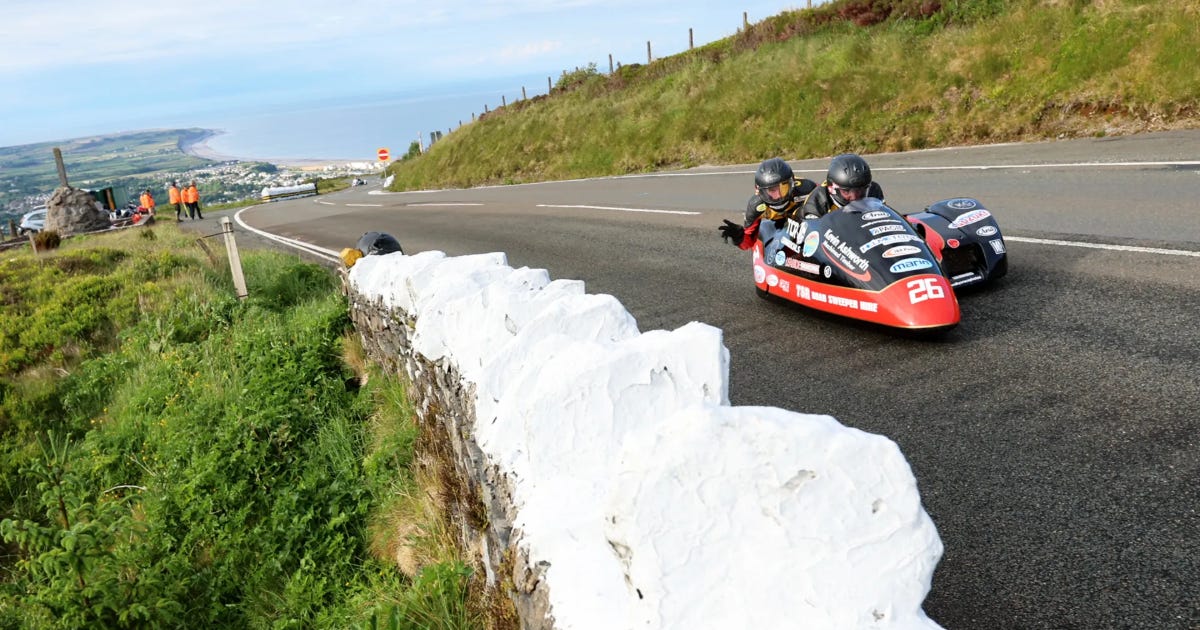
Sidecar: While the engine capacity is based in the solo Supersport regulations, sidecars feature a purpose-built chassis and owe more in design to open wheel car racing than that of a two-wheel racing bike. Stationed in a kneeling position over the bike, the rider controls speed, steering and braking while the passenger moves around in the adjacent plaform to aid steering and traction. Powered by 600cc 4-cylinder, 675cc- 3-cylinder and 900cc parallel-twin engines. The lap record is Ryan and Callum Crowe’s 18:42.350 at a 121.021mph average on a Honda LCR-powered outfit in 2025.
NB: Information for this feature was compiled from the excellent ttplus.iomttraces.com